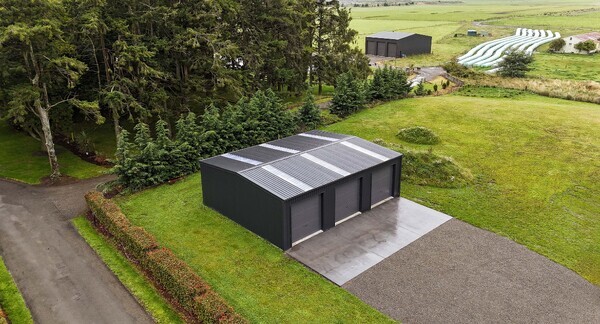
How Close to the Boundary Can You Build a Shed?
If you’re planning a shed on rural land, one of the first questions you’ll probably ask is: how close can I build to the boundary?
The answer depends on your property, your council, and the zone your land sits in. In this article, we cover the typical setback distances that can apply between your shed and the road boundary, as well as the spacing required from neighbouring properties.
This guide is intended as a general reference only and focuses on standard rural sheds. Council rules can and do change over time, and the information below is based on operative district plans available as of August 2024. You should always confirm your exact setback requirements with your local council before building. If you want help understanding what may apply to your site, the Easy Kit team can also point you in the right direction.
North Island
Far North District Council
Typical setbacks in the Rural Production Zone are:
- Road boundary: 10 metres
- Side boundary: 10 metres
For sites under 5,000m², accessory buildings may be able to sit 3 metres from the side and rear boundaries, subject to recession plane rules.
Far North has three rural zones: Rural Production, Rural Living, and Minerals. The figures above relate to the Rural Production Zone, which covers most rural land in the district.
Kaipara District Council
Typical setback requirements are:
- Road boundary: 10 metres
- Road boundary for industrial/commercial use: 20 metres
- Side boundary: 3 metres
Recession plane rules can also apply.
There may also be extra setback requirements around areas such as:
- Coastal Marine Areas
- Indigenous wetlands
- State highways
- Plantation forestry
- Lakes and rivers
These can range from 30 metres to 300 metres, so checking your site carefully is important.
Auckland Council
Auckland’s rural land falls across five different zones under the Unitary Plan, including:
- Rural Production
- Mixed Rural
- Rural Coastal
- Rural Conservation
- Countryside Living
Setbacks vary depending on the zone, but in general, they are around:
- Road boundary: 10 metres
- Arterial road boundary: 20 metres
- Side and rear boundary: 12 metres
Waikato District Council
Setbacks depend on both land size and location.
Road boundary:
- Over 1.6ha: 12 metres
- Under 1.6ha: 7.5 metres
- Near the Waikato Expressway: 25 metres
- Near a state highway: 15 metres
Side boundary:
- Under 1.6ha: 12 metres
- Over 1.6ha: 25 metres
The above applies to the Waikato section of the district. The Franklin section has different requirements, generally around 10 metres to side boundaries and 10 to 20 metres to road boundaries, depending on the road type.
Matamata-Piako District Council
Rural Zone
- Road boundary: 25 metres
- Side boundary: 10 metres
For properties under 2,500m²:
- Road boundary: 15 metres
- Side boundary: 10 metres, or 5 metres where the adjoining property is 1 hectare or less
Rural Residential Zone
- Road boundary: 25 metres
- Side boundary: 10 metres
Ōtorohanga District Council
Setbacks are generally:
- Road boundary: 7 to 15 metres
- Side boundary: 15 metres
In most cases the road setback is 7 metres, increasing to 15 metres where the site is near a state highway or regional arterial route.
Rotorua Lakes Council
Rotorua has three rural-style zones, each with different setback rules.
Working Rural Zone
- Road boundary: 10 metres
- Side boundary: 10 metres
Rural Lifestyle Zone
- Road boundary: 7.5 metres
- Side boundary: 7.5 metres
Rural Village Zone
- Road boundary: 5 metres
- Side boundary: 2.5 metres
Taupō District Council
Typical setbacks are:
- Road boundary: 25 metres
- Side boundary: 15 metres
- Side boundary next to Residential Environment boundaries: 25 metres
- New Plymouth District Council
Rural Production Zone
- Road boundary: 20 metres
Side boundary:
- Agricultural, pastoral and horticultural activity structures: 10 metres
- Artificial crop protection and crop support structures: 3 metres
- All other structures, including rural industry buildings: 15 metres
Rural Lifestyle Zone
- Road boundary: 10 metres
Side boundary:
- Adjoining Rural-zoned land: 5 metres
- Adjoining Residential, Commercial, Mixed Use, General Industrial, Open Space, Recreation, or Special Purpose zones: 15 metres
- Adjoining Future Urban Zone: 30 metres
Recession plane rules may also apply.
Rangitīkei District Council
Typical setbacks are:
- Road boundary: 5 metres
- Side boundary: 5 metres
- Boundary beside an existing state highway: 10 metres
Hastings District Council
For accessory buildings linked to residential and land-based primary production use:
- Road boundary: 7.5 metres
- Side boundary: 5 metres
Central Hawke’s Bay District Council
Typical setbacks are:
- Road boundary: 20 metres
- Side boundary: 10 metres
For a residential-use garage, these can reduce to:
- Road boundary: 5 metres
- Side boundary: 5 metres
Horowhenua District Council
Standard setbacks are:
- Road boundary: 10 metres
- Side boundary: 10 metres
- State highway boundary: 15 metres
For sites smaller than 5,000m², the side boundary setback may reduce to 3 metres.
Masterton District Council
Setbacks depend on road type:
- Road boundary on sealed roads: 10 metres
- Road boundary on unsealed roads: 25 metres
- Side boundary: 5 metres
Recession planes may also apply, and extra rules can be triggered near waterbodies.
Upper Hutt City Council
For the Rural Production Zone, typical setbacks are:
- Road boundary: 12 metres
- Side boundary: 12 metres
In some cases recession plane controls also apply.
Upper Hutt includes several rural-style zones, so it is important to confirm which zone your site falls within.
South Island
Kaikōura District Council
Typical requirements are:
- Road boundary: 10 metres
- Distance to residential unit on adjoining site: at least 10 metres
Hurunui District Council
Typical setbacks are:
- Road boundary: 10 metres
- Road boundary beside strategic arterial, district arterial, or collector roads: 25 metres
- Side boundary: 1 metre
If a wall exceeds 30 metres in length, the side setback can increase to 25 metres.
Waimakariri District Council
Typical setbacks are:
- Road boundary: 10 metres
- Side boundary: 3 metres
Selwyn District Council
Typical setbacks are:
- Road boundary: 10 metres
- Side boundary: 5 metres
- Side boundary on sites under 1 hectare: 3 metres
Westland District Council
Typical setbacks are:
- Road boundary: 10 metres
- State highway boundary: 20 metres
- Side boundary: 3 metres
Ashburton District Council
Typical setbacks are:
- Road boundary: 10 metres
- Side boundary: 3 metres
For State Highway 1 and State Highway 77, the setback increases to 20 metres from the left edge of the nearest traffic lane for residential units.
Mackenzie District Council
Typical setbacks are:
- Road boundary: 20 metres
- Side boundary: 6 metres
For buildings facing SH8, SH79, or SH80, road setbacks can range from 20 to 50 metres, so site-specific checks are essential.
Timaru District Council
For Rural R1, R2, and R3 areas:
- Road boundary: 6 metres
- Side boundary: 3 metres
Recession plane requirements may also apply.
Waimate District Council
Typical setbacks are:
- Road boundary: 7.5 metres
Side boundary:
- Residential units and residential accessory buildings: 20 metres
- Other rural buildings: equal to the building height
For example, a 4 metre high shed would require a 4 metre side setback.
Waitaki District Council
For the Rural Zone, typical setbacks are:
- Road boundary: 15 metres
- State highway boundary: 20 metres
- Side boundary: 6 metres
Waitaki has both Rural Residential and Rural zones, so the exact rules will depend on your land.
Gore District Council
Typical setbacks are:
- Road boundary: 6 metres
- Side boundary: 6 metres
Recession planes may also apply.
Southland District Council
Typical setbacks are:
- Road boundary: 4.5 metres
- Side boundary: minimum 1 metre
Height recession planes also apply, which can affect how close you can actually build.
Other Things That Can Affect Shed Setbacks
Boundary setbacks are not always straightforward. In many cases, there are other overlays, land features, or use-specific rules that can change what is allowed.
Examples include:
- sheds used for housing animals
- dairy sheds, shearing sheds, or similar farm buildings
- waterways, dams, and floodbanks
- coastal areas
- landscape overlays such as Outstanding Natural Features or Visual Amenity Landscapes
These can all increase setbacks or introduce extra conditions.
What Are Recession Planes?
In some zones, especially Residential and Rural Residential areas, your shed may also need to comply with a recession plane.
A recession plane is an imaginary angled line that helps protect sunlight access for neighbouring properties. Because the winter sun sits lower in the southern sky, the rules are often stricter on southern boundaries and more relaxed on northern boundaries.
These lines usually begin 2 to 3 metres above ground level and angle upward somewhere between 35 and 60 degrees, depending on the district plan and the site orientation.
If your council uses a variable recession plane, the district plan will usually include a diagram showing how to work it out.
What If You Want to Build Closer to the Boundary?
If your proposed shed does not meet the minimum setback or recession plane rules, there are generally two possible pathways.
1. Resource Consent
This is the standard approval route. Depending on how much your shed affects neighbouring properties, written approval from the neighbour may or may not be required.
2. Deemed Permitted Boundary Activity (DPBA)
This is a faster and usually cheaper process than a full resource consent. It requires:
- affected neighbour approval
- a signed affected party form
- a site plan
- elevation drawings
If the application is complete and signed by the affected neighbour, council cannot refuse a DPBA.
Check Before You Build
Setback rules vary widely across New Zealand, and even within the same district, they can change depending on zone, road type, site size, and what the building will be used for.
That is why this information should be treated as a starting point only. Before you commit to a shed location, check the current district plan and confirm your site-specific requirements with your local council.
Not sure what may apply to your property? Get in touch with the Easy Kit team, and we can help point you in the right direction before you get too far into planning.